

Research
Graphene for water purification
Graphene oxide adsorbents and graphene-filled membranes that remove dyes, salts and other pollutants from water, designed for high capacity and for reuse over many cycles.
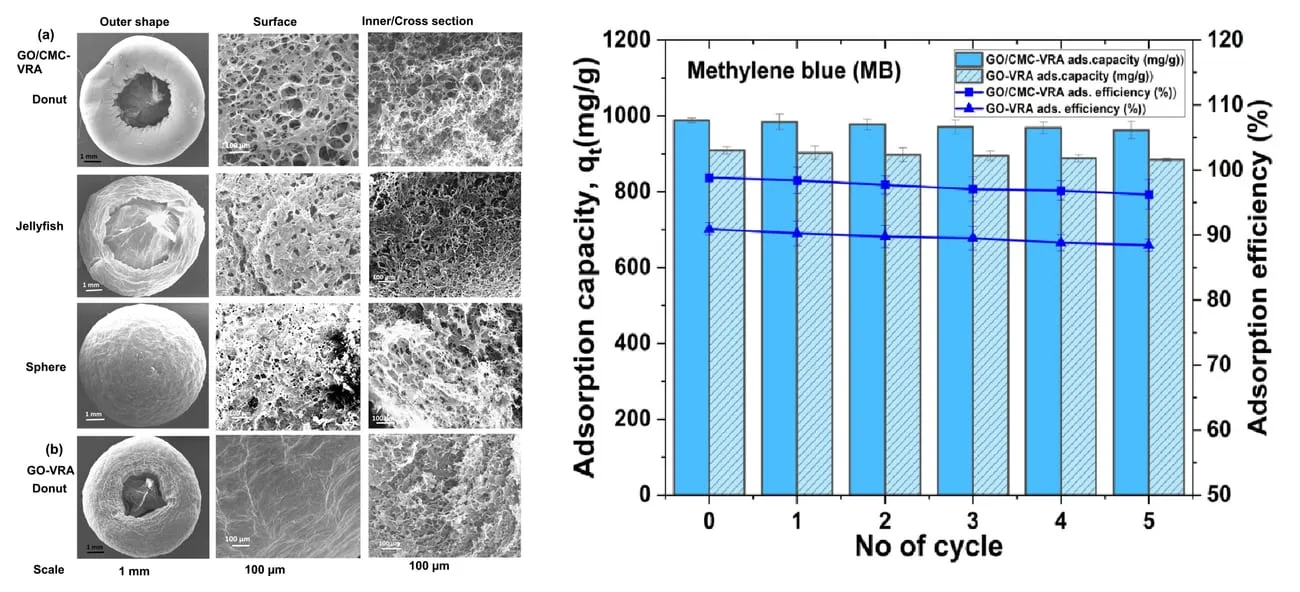
Industrial wastewater carries dissolved dyes and other organic pollutants that are harmful even at very low concentrations. The group makes graphene oxide vortex-ring particles, millimetre-sized porous aerogels whose donut shape gives high adsorption efficiency. Functionalising them with carboxymethyl cellulose lets the same particles remove both cationic and anionic dyes (methylene blue and methyl orange), and they can be regenerated and reused.
With chemical engineering colleagues, the group also adds functionalised graphene oxide to polymer membranes: in polyethersulfone it moves the membranes from ultrafiltration to nanofiltration, and in PVDF it improves membrane distillation for desalination.
UN Sustainable Development Goals








This theme contributes to the goals above. More on the goals at the United Nations Sustainable Development Goals site. The content of this publication has not been approved by the United Nations and does not reflect the views of the United Nations or its officials or Member States.
Publications 6
Core-shell graphene oxide and Carboxymethyl cellulose Vortex ring aerogel particles for the adsorptive removal of contrasting azo dyes from water
Fabrication of graphene oxide vortex ring particle for efficient adsorptive removal of organic dyes from water
Polyethersulfone membranes: From ultrafiltration to nanofiltration via the incorporation of APTS functionalized-graphene oxide
PVDF membranes containing reduced graphene oxide: Effect of degree of reduction on membrane distillation performance
Flux-enhanced PVDF mixed matrix membranes incorporating APTS-functionalized graphene oxide for membrane distillation
High flux and fouling resistant flat sheet polyethersulfone membranes incorporated with graphene oxide for ultrafiltration applications