

Research
Graphene oxide dispersions and liquid crystals
How graphene oxide flakes behave and assemble in water, from liquid-crystal phases and flow instabilities to droplets that self-assemble into shaped hydrogel and aerogel particles.
At modest concentrations, graphene oxide flakes in water line up into a liquid-crystal phase. The group studies how these phases respond to flow, confinement and added molecules: large flakes, for example, show elastic flow instabilities that appear as helical bands under shear.
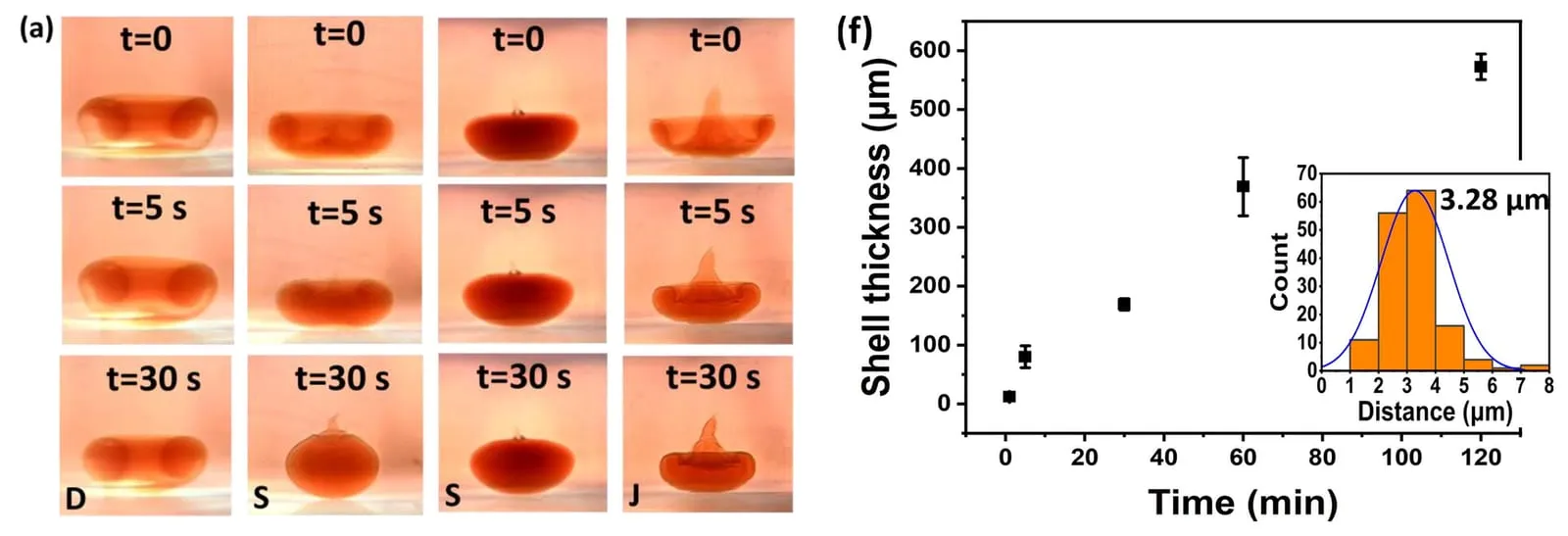
When a drop of graphene oxide dispersion falls into a solution of oppositely charged surfactant, the vortex-ring effect and electrostatic attraction together shape it into a hydrogel particle with a shell of aligned flakes. High-speed imaging shows spheres, donuts and jellyfish forming in real time, and the conditions that select each shape. Freeze-dried, these particles become the aerogels used in the group’s water purification work.
UN Sustainable Development Goals






This theme contributes to the goals above. More on the goals at the United Nations Sustainable Development Goals site. The content of this publication has not been approved by the United Nations and does not reflect the views of the United Nations or its officials or Member States.
Publications 7
Tuneable electrohydrodynamics of core-shell graphene oxide vortex rings
Hybrid molecular/mineral lyotropic liquid crystal system of CTAB and graphene oxide in water
Elastic flow instabilities and macroscopic textures in graphene oxide lyotropic liquid crystals
Initial Studies Directed toward the Rational Design of Aqueous Graphene Dispersants
Confinement effects on lyotropic nematic liquid crystal phases of graphene oxide dispersions
Dielectric spectroscopy of isotropic liquids and liquid crystal phases with dispersed graphene oxide
Properties of a Thermotropic Nematic Liquid Crystal Doped with Graphene Oxide