

Research
Graphene MEMS, sensors and devices
Ultra-thin graphene–polymer membranes for pressure sensors and other micro- and nano-electromechanical devices, their mechanics and modelling, and fabrication routes compatible with standard MEMS processes.
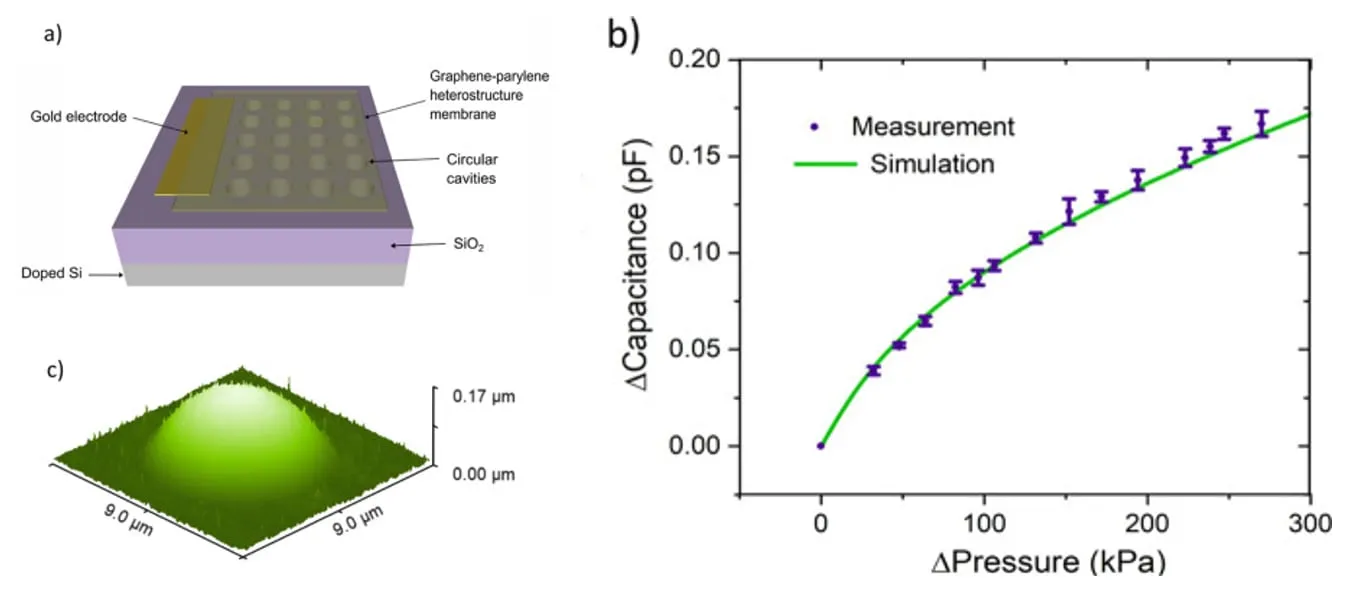
A graphene layer supported by a few tens of nanometres of polymer makes a membrane thin enough to deflect under small pressures yet robust enough to manufacture. The group builds capacitive pressure sensors from these graphene–polymer heterostructure membranes and, with applied mathematicians, models them with the Föppl–von Kármán equations, which capture bending and stretching together; simulated and measured membrane shapes and sensor responses agree closely.
Related work covers pristine graphene ultramicroelectrodes, nanometre-scale electron-beam patterning of suspended graphene–boron nitride membranes, and integrating graphene membranes into multi-user MEMS fabrication. This line of research led to the spin-out company Atomic Mechanics.
UN Sustainable Development Goals


This theme contributes to the goals above. More on the goals at the United Nations Sustainable Development Goals site. The content of this publication has not been approved by the United Nations and does not reflect the views of the United Nations or its officials or Member States.
Publications 8
Modeling Graphene–Polymer Heterostructure MEMS Membranes with the Föppl–von Kármán Equations
Fabrication and electrochemical response of pristine graphene ultramicroelectrodes
Nanometre electron beam sculpting of suspended graphene and hexagonal boron nitride heterostructures
Touch-mode capacitive pressure sensor with graphene-polymer heterostructure membrane
Capacitive pressure sensing with suspended graphene–polymer heterostructure membranes
Ultra-thin graphene–polymer heterostructure membranes
Ultrafast quantitative nanomechanical mapping of suspended graphene
Graphene Sensors