

Research
Graphene biointerfaces and biomedical materials
How proteins, cells and tissues interact with graphene and graphene oxide, applied to cell arrays, regenerative hydrogels, nerve repair and low-cost biosensors.
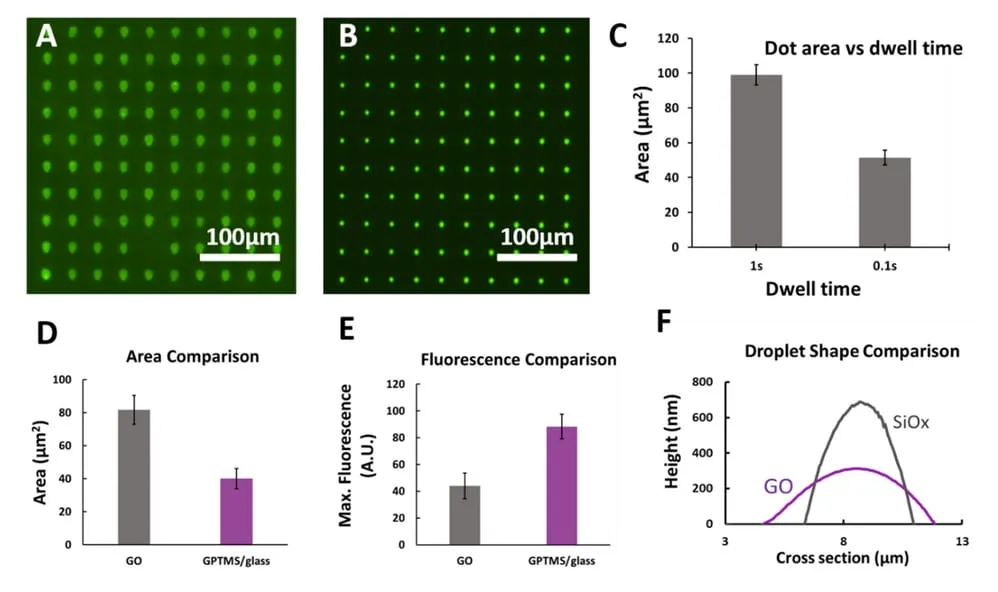
Graphene oxide coatings can be patterned with protein spots that capture cells one at a time: on fibronectin arrays printed onto graphene oxide, cells adhered better and single-cell occupancy was higher than on silanised glass, a simple route to cell arrays for screening.
With biomedical collaborators, the group studies graphene oxide in self-assembling peptide hydrogels for intervertebral disc repair, graphene oxide substrates that support Schwann-like stem cells for nerve regeneration, and a low-cost quartz-crystal-microbalance immunosensor with a graphene biointerface that measured a kidney-disease antibody in undiluted patient serum.
UN Sustainable Development Goals



This theme contributes to the goals above. More on the goals at the United Nations Sustainable Development Goals site. The content of this publication has not been approved by the United Nations and does not reflect the views of the United Nations or its officials or Member States.
Publications 22
Acidic and basic self-assembling peptide and peptide-graphene oxide hydrogels: characterisation and effect on encapsulated nucleus pulposus cells
Biochemical functionalization of graphene oxide for directing stem cell differentiation
TGF-β3-loaded graphene oxide - self-assembling peptide hybrid hydrogels as functional 3D scaffolds for the regeneration of the nucleus pulposus
Development of an open-source thermally stabilized quartz crystal microbalance instrument for biomolecule-substrate binding assays on gold and graphene
Graphene Oxide Substrate Promotes Neurotrophic Factor Secretion and Survival of Human Schwann‐Like Adipose Mesenchymal Stromal Cells
On the biocompatibility of graphene oxide towards vascular smooth muscle cells
A Point-of-Care Immunosensor Based on a Quartz Crystal Microbalance with Graphene Biointerface for Antibody Assay
Protein interactions and conformations on graphene-based materials mapped using a quartz-crystal microbalance with dissipation monitoring (QCM-D)
Graphene oxide containing self-assembling peptide hybrid hydrogels as a potential 3D injectable cell delivery platform for intervertebral disc repair applications
Graphene oxide films for field effect surface passivation of silicon for solar cells
Improving the glial differentiation of human Schwann-like adipose-derived stem cells with graphene oxide substrates
Designing Peptide/Graphene Hybrid Hydrogels through Fine-Tuning of Molecular Interactions
Adsorption and binding dynamics of graphene-supported phospholipid membranes using the QCM-D technique
Biomimetic Phospholipid Membrane Organization on Graphene and Graphene Oxide Surfaces: A Molecular Dynamics Simulation Study
Fabrication and modelling of fractal, biomimetic, micro and nano-topographical surfaces
Graphene Oxide promotes embryonic stem cell differentiation to haematopoietic lineage
Dispersal of pristine graphene for biological studies
Self-limiting multiplexed assembly of lipid membranes on large-area graphene sensor arrays
Graphene oxide selectively targets cancer stem cells, across multiple tumor types: Implications for non-toxic cancer treatment, via “differentiation-based nano-therapy”
Self-assembly of one dimensional DNA-templated structures
Multiplexed biomimetic lipid membranes on graphene by dip-pen nanolithography
In Vitro Transcription and Protein Translation from Carbon Nanotube–DNA Assemblies